On the line, heat is never just heat. It’s the line between a pane that comes out flat and stress-free, and one that shows optical distortion or cracks after tempering. When a coating needs to dry without blisters, or a laminate stack needs a controlled melt without scorching, the heat has to hit the same spot, the same way, every time.
Dat de warmte op de lijn niet zomaar warmte is. Het is het verschil tussen een glasplaat die vlak en spanningsvrij uit de lijn komt, en een plaat die optische vervormingen of scheuren vertoont na het hardingsproces. Wanneer een coating droog moet worden zonder blaasvorming, of een laminatenstapel gecontroleerd moet smelten zonder aanbranding, moet de warmte elke keer op exact dezelfde plek en op dezelfde manier worden aangebracht.
That’s where gold-coated infrared emitters earn their keep.
Daar komt het nut van goudgecoate infraroodstralers naar voren.
What matters, technically
Wat technisch van belang is
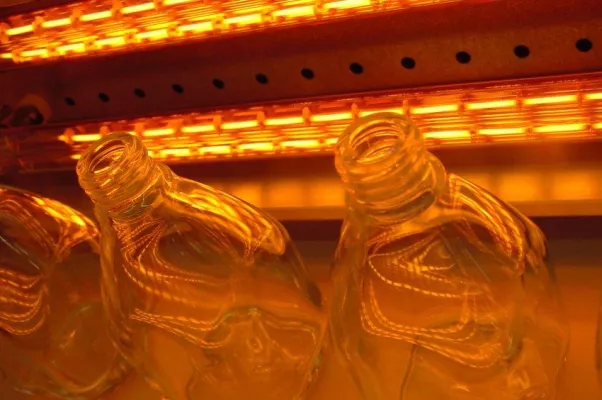
These emitters put out short-wave radiation with high emissivity and tight spectral control. The gold layer reflects longer wavelengths back toward the filament, which boosts efficiency and keeps output stable. In practice, you get a uniform thermal field across the target, a near-instant warm-up, and directional radiation that doesn’t waste heat on the surroundings.
Deze stralers geven kortegolfstraling af met een hoge emissiviteit en nauwkeurige spectrale controle. De goudlaag reflecteert langere golflengten terug naar het filament, wat de efficiëntie verhoogt en de output stabiel houdt. In de praktijk resulteert dit in een uniform thermisch veld over het doeloppervlak, een vrijwel onmiddellijke opwarming en gerichte straling die geen warmte verspilt aan de omgeving.
The payoff is predictable temperature profiles, fewer thermal gradients, and less drift from one batch to the next.
Het resultaat is voorspelbare temperatuurprofielen, minder thermische gradients en minder variatie tussen productiebatches.
Why this fits glass processing
Waarom dit geschikt is voor glasverwerking
We run on throughput and yield. In tempering and bending, uniform heating cuts edge stress and bow, and that shows up as better optical quality. In lamination—whether you’re running EVA, SGP, or PVB—fast, even heat shortens the cycle while keeping bubbles and delamination out of the conversation.
Onze productie draait om doorvoer en opbrengst. Bij het harden en buigen vermindert gelijkmatige verwarming de randspanningen en het doorbuigen, wat zich vertaalt in betere optische kwaliteit. Bij lamineren—of het nu EVA, SGP of PVB is—verkort snelle en gelijkmatige warmte de cyclustijd en voorkomt het blazen en delaminatie.
For coating drying, directional radiation cures evenly without overheating the substrate, so the film stays intact. Energy use drops because the energy goes where it’s needed, not into heating air or fixtures. Out on the floor, you see lines settling at setpoints faster, with fewer scrapped sheets and less downtime chasing temperature swings.
Bij het drogen van coatings zorgt gerichte straling voor een gelijkmatige uitharding zonder oververhitting van het substraat, waardoor de laag intact blijft. Het energieverbruik daalt omdat de energie wordt gericht waar het nodig is, in plaats van lucht of apparatuur te verwarmen. Op de werkvloer betekent dit dat lijnen sneller op de ingestelde waarden komen, met minder afgekeurde platen en minder stilstand door temperatuurfluctuaties.
What you need to keep straight
Waar u op moet letten
Installation is straightforward, but alignment and reflector condition matter. Keep the target distance within the design window; if you push it too far, uniformity goes sideways. Keep the emitter surface clean and dry, and make sure voltage at the terminals is stable.
De installatie is eenvoudig, maar de uitlijning en de staat van de reflector zijn cruciaal. Houd de afstand tot het doel binnen het ontwerpbereik; als die te groot wordt, verslechtert de uniformiteit. Houd het oppervlak van de straler schoon en droog en zorg voor een stabiele spanning aan de aansluitklemmen.
Expect shorter lamp life if you run extreme duty cycles in high humidity. Match the emitter to your process window—power density, dwell time, and glass type—and it behaves like a fixed tool, not a guess.
Houd rekening met een kortere levensduur van de lamp bij zware bedrijfscycli in hoge vochtigheid. Stem de straler af op uw procesparameters—vermogendichtheid, verblijftijd en glassoort—en het functioneert als een vast gereedschap, niet als een gok.