Fixing Those Pesky Cold Spots in Glass Annealing
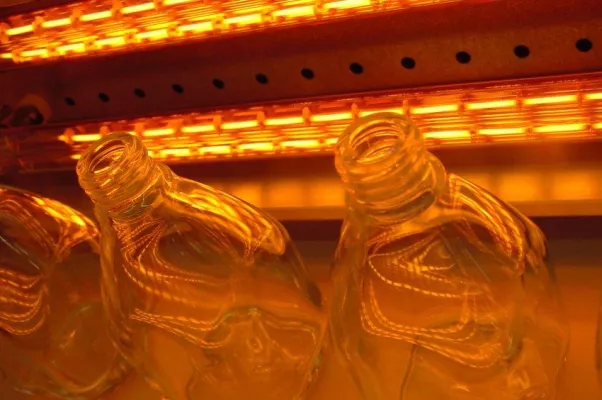
If you’ve ever worked with flasks, narrow-neck vials, or tapered tubes, you know the headache of “dead zones.” You pull a piece out of a standard kiln, thinking you’re good to go, only for it to shatter spontaneously. It’s frustrating. The problem is that standard convection or resistive heating just can’t get into those tight corners. The heat doesn’t “turn the corner” well, leaving cold spots that create internal stress. To fix this, we stopped relying on hot air and started using high-density infrared (IR) quartz heaters. Why IR actually works Think of it this way: air-based heating is like trying to warm up a room with a fan. Infrared is more like standing in the sun. It travels in a straight line and hits the glass directly. By setting up quartz lamps in a multi-angle array, we can basically “shine” heat into the shadows of the vessel. Because we use short-wave IR, it doesn’t need the air to carry it. It hits the surface and turns into heat instantly. No waiting around for the air to circulate. The gear we use We use high-purity quartz envelopes because they can handle the brutal heat cycles of annealing without giving up. Depending on how much space you have in your kiln, we tweak the length and wattage of the lamps to get the heat density just right. And because nobody wants to spend their afternoon rewiring a rack, we use standard R7s or Sk15 connectors. If a lamp burns out, you just pop it out and slide a new one in. It takes minutes. The trade-offs (because nothing is perfect) Here’s the thing: these high-wattage tubes ramp up the heat incredibly fast, which is great for precision. But they also put out a lot of concentrated energy. If you cram too many lamps in there just to kill every last dead zone, you might actually start overheating the kiln’s own frame. You’ve got to make sure your insulation and cooling fans are up to the task. We’ve found that a staggered layout is the way to go. It lets the radiant heat hit the shoulders and the base of the glass at the same time. You get a smooth, even temperature across the whole piece, and you can finally stop worrying about your glassware exploding.